Digital Marketing Strategies for Startups: A Practical Guide
Why Digital Marketing Strategy Matters for Startups
Startups face tight budgets, small teams, and limited runway. Digital marketing can drive awareness, leads, and revenue—but only if it is strategic. Random tactics (a few blog posts here, a small ad spend there) rarely move the needle. What works is a clear foundation (goals, audience, positioning) and a focused set of channels you execute consistently.
This guide covers digital marketing strategies that fit early-stage constraints: what to do first, which channels to prioritize, how to think about budget, and common mistakes to avoid. For the broader context of growth and traction inside a startup, see our company building guide.
Start With the Foundation
Before you invest in channels or tools, get the basics right. Tactics without strategy waste time and money.
Goals, Audience, and Positioning
Define SMART goals (specific, measurable, achievable, relevant, time-bound) for what marketing should achieve: e.g. signups, leads, or revenue in a given period. Know who you are selling to: who has the problem, where they look for solutions, and what messaging resonates. That clarity drives channel choice and creative. Track a few key metrics—conversion rate, customer acquisition cost (CAC), and customer lifetime value (LTV)—so you can tell what is working.
Don't Scale Marketing Before Product-Market Fit
If you have not yet proven that people want your product and will pay for it, pouring money into paid ads or big content pushes is risky. Marketing amplifies something that already works. Use early marketing to test messaging and channels with small budgets; scale spend once you have evidence of fit and repeatable acquisition. For more on finding traction, see the growth section of our company building guide.
Core Digital Marketing Strategies
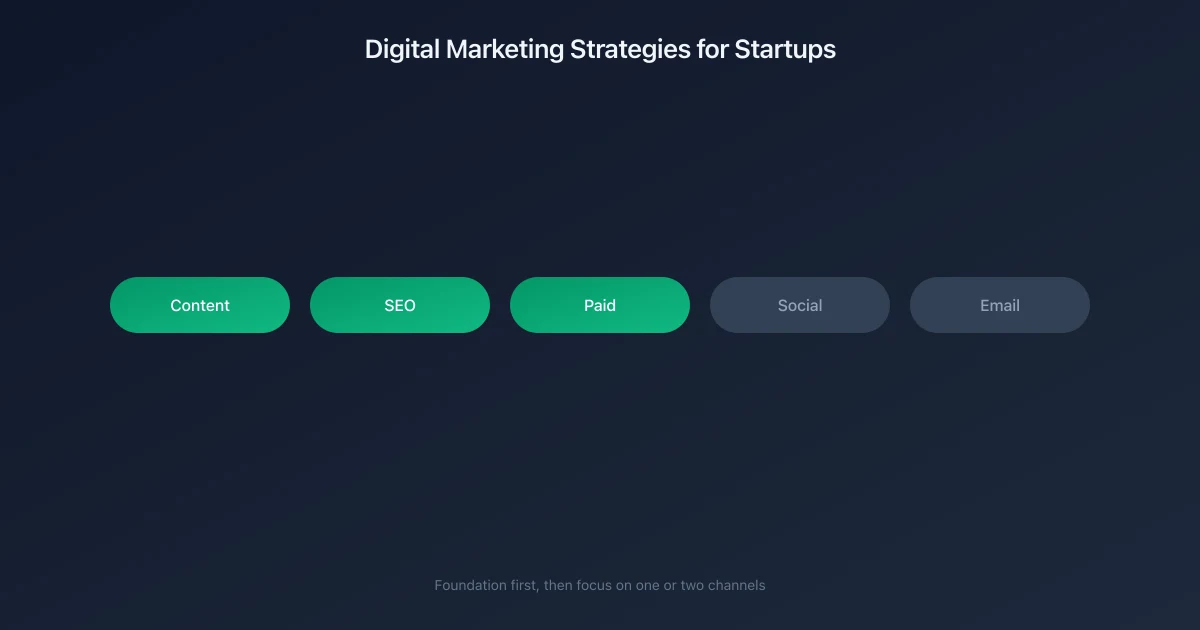
These five areas cover most of what startups use: content, SEO, paid ads, social and community, and email. You do not need to do all of them at once. Pick one or two, execute well, then expand.
Content Marketing
Create valuable, relevant content that answers your audience's questions and builds trust before they buy. Blog posts, guides, and videos can attract organic traffic and position you as an authority. Repurpose content across formats (e.g. blog to social, to email). Focus on topics that map to your product and to search demand—long-tail keywords often have lower competition and higher intent. Content compounds over time; it is an asset that keeps working.
SEO and Organic Search
Search engine optimization helps you show up when people look for solutions. Target long-tail keywords with clear intent; use on-page SEO (titles, headings, meta descriptions) and basic technical SEO (fast site, clear structure). Tools like Google Keyword Planner are free; tools like SEMrush or Ahrefs offer deeper data. SEO typically takes 3–6 months or more to show meaningful traffic but can deliver strong ROI once it compounds. For many B2B startups, SEO is the highest-ROI channel over time.
Paid Advertising
Paid ads (Google, Meta, LinkedIn, etc.) deliver results quickly—often within days or weeks. Start small: even modest daily budgets let you test creatives and audiences before scaling. Meta and Google remain the dominant platforms for most startups. Use paid to validate messaging and capture intent; combine with organic so you are not dependent on spend. When runway is short (e.g. under six months), paid can be necessary to generate leads fast while you build organic assets.
Social and Community
Choose one or two platforms where your audience actually is—LinkedIn for B2B, Instagram or TikTok for consumer, X/Twitter for dev or founder audiences. Short-form video (Reels, TikTok) works for awareness; founder-led storytelling builds trust. Community (e.g. newsletter, Slack, events) keeps people engaged and can turn into a retention and referral channel. Do not spread yourself across every platform; one channel executed well beats many done poorly.
Email Marketing
Email is a direct, owned channel. Use automated flows (welcome, onboarding, win-back) and a regular newsletter to nurture leads and stay top of mind. Personalization and relevance matter more than volume. Email supports retention and repeat engagement; for many startups it is one of the highest-converting channels once you have a list.
| Channel | Cost | Speed | Best for |
|---|---|---|---|
| Content + SEO | Low to medium (time/tools) | Slow (months) | Long-term traffic, authority, high ROI over time |
| Paid ads | Medium to high | Fast (days–weeks) | Immediate leads, testing, short runway |
| Social | Low to medium | Medium | Awareness, community, founder brand |
| Low | Medium | Nurture, retention, owned audience |
Budget and Resource Reality
Startups often allocate 15–30% of revenue to growth when pushing aggressively; median B2B SaaS marketing spend is lower (around 8% of ARR). The important part is how you allocate, not just how much you spend. When cash is limited, prioritize organic-first: content, SEO, and email cost little beyond time and tools. Add paid once you have messaging and conversion evidence. A small budget (e.g. $5K–$10K/month) is better focused on one or two channels done well than spread across many. Basic needs—website, analytics, keyword research—can be covered with low-cost or free tools (e.g. Google Analytics, Keyword Planner, Google Business Profile).
A Practical First-90-Days Checklist
Use the first 90 days to build foundation and momentum rather than chasing every tactic.
- Weeks 1–2: Clarify goals, audience, and positioning; define 1–2 KPIs you will track.
- Weeks 2–4: Ensure your site is fast, clear, and has basic SEO (titles, key pages). Set up analytics and conversion tracking.
- Month 1–2: Choose one primary channel (e.g. content + SEO, or one paid platform) and run a small test. Create a few pieces of content or a small ad campaign; measure response.
- Month 2–3: Double down on what works. Add a second channel only if the first is showing signal. Document what you learn so you can repeat and scale.
Break the plan into 90-day sprints. Every action should tie back to your strategy—avoid random tasks that do not connect to a goal.
Common Digital Marketing Mistakes to Avoid
Spending heavily before product-market fit. Marketing spend amplifies demand. If the product is not yet validated, you risk burning budget on something people do not want. Validate first; scale spend after.
Shiny object syndrome. Jumping between TikTok, newsletters, AI tools, and every new channel dilutes impact. Choose one or two levers, master them, then expand.
Chasing vanity metrics. Followers and likes feel good but do not always drive revenue. Focus on metrics that tie to business outcomes: signups, leads, conversion, retention.
Content without distribution. Creating content without a plan to distribute it (email, social, paid boost) limits reach. Balance creation (fuel) with distribution (engine).
Outsourcing strategy too early. Agencies execute; they need clear goals, voice, and direction from you. Handing marketing to an agency before you know what works often produces generic, low-impact work. Define your strategy and voice first; then bring in help for execution if needed.
Copying another company's playbook. What works for one startup may not fit your audience, stage, or strengths. Build strategy around your specific situation and advantages.
Conclusion
Digital marketing strategies for startups work when they start with a clear foundation—goals, audience, and positioning—and focus on one or two channels executed well. Content and SEO build long-term assets; paid ads deliver speed when you need it; social and email build community and retention. Match your mix to your runway and stage: organic-first when cash is tight, add paid when you have proof and need volume. Avoid scaling spend before product-market fit, chasing every new channel, and confusing activity with strategy.
For more on growth and traction in the early stage, see our company building guide. For raising capital to fund growth, see pre-seed funding for startups and how to raise Series A. To explore the broader ecosystem, read our startup ecosystem guide.
Frequently Asked Questions
What are the best digital marketing channels for startups?
It depends on your audience and stage. Content marketing and SEO often deliver the highest long-term ROI for B2B; paid ads (Meta, Google) give fast results when you need leads quickly. Email and one or two social platforms where your audience is active are strong supporting channels. Start with one or two channels and master them before adding more.
How much should a startup spend on marketing?
Many startups allocate 15–30% of revenue to growth when pushing hard; median B2B SaaS spend is lower (around 8% of ARR). When cash is limited, focus on organic channels (content, SEO, email) and small paid tests. Allocate budget to the channels that show measurable return, not evenly across everything.
When should a startup start digital marketing?
Start as soon as you have a clear offer and target audience. You can do foundational work (positioning, site, analytics) and light content or social before product-market fit. Scale paid and heavy content production after you have evidence that people want and will pay for your product.
What is the difference between content marketing and paid ads for startups?
Content marketing (blog, SEO, video) builds organic traffic and authority over months; it compounds and keeps working. Paid ads deliver traffic and leads quickly but stop when you stop spending. Content typically has higher long-term ROI; paid is better when you need immediate results or have short runway. Many startups use both: paid for speed, content for long-term asset.
How do I create a digital marketing strategy for a startup?
Define goals (e.g. signups, revenue), audience, and positioning first. Choose one or two channels that fit your audience and resources (e.g. content + SEO, or paid + email). Set KPIs (CAC, conversion, LTV) and track them. Execute consistently for 90 days, double down on what works, then expand. Avoid spreading effort across every channel at once.
What are common startup marketing mistakes?
Spending heavily before product-market fit, jumping between too many channels, chasing vanity metrics (followers, likes), creating content without distribution, and outsourcing strategy before you know what works. Focus on foundation, one or two channels, and metrics that tie to business outcomes.
Is SEO worth it for early-stage startups?
Yes, if you have 6+ months of runway and can commit to consistent content and optimization. SEO takes 3–6 months or more to show meaningful traffic but compounds over time and often delivers the highest ROI of any channel for B2B. When runway is very short, paid ads may be necessary while you build SEO in parallel.
References
- Marketing playbook: Digital marketing strategies – Think with Google
- How to Create a Marketing Budget for Startups – SCORE
- Budget-Friendly Digital Marketing Tools – Buffer
- Low-Cost Digital Marketing Strategies for Startups – AllBusiness