How to Raise Series A Funding: Process, Metrics & Checklist
What Is Series A Funding?
Series A funding is a startup's first significant round of institutional venture capital. Unlike seed or pre-seed, which often use convertible instruments like SAFEs, Series A is typically a priced round: investors buy preferred stock at an agreed valuation and often receive board rights and governance terms.
At this stage, investors are no longer betting only on the idea or the team. They are betting on proof: product-market fit, repeatable growth, and a path to scale. The capital is used to grow the business beyond founder-led execution—hiring, expanding into new markets, and building systems that can support the next phase of growth.
Series A vs Seed: What's the Difference?
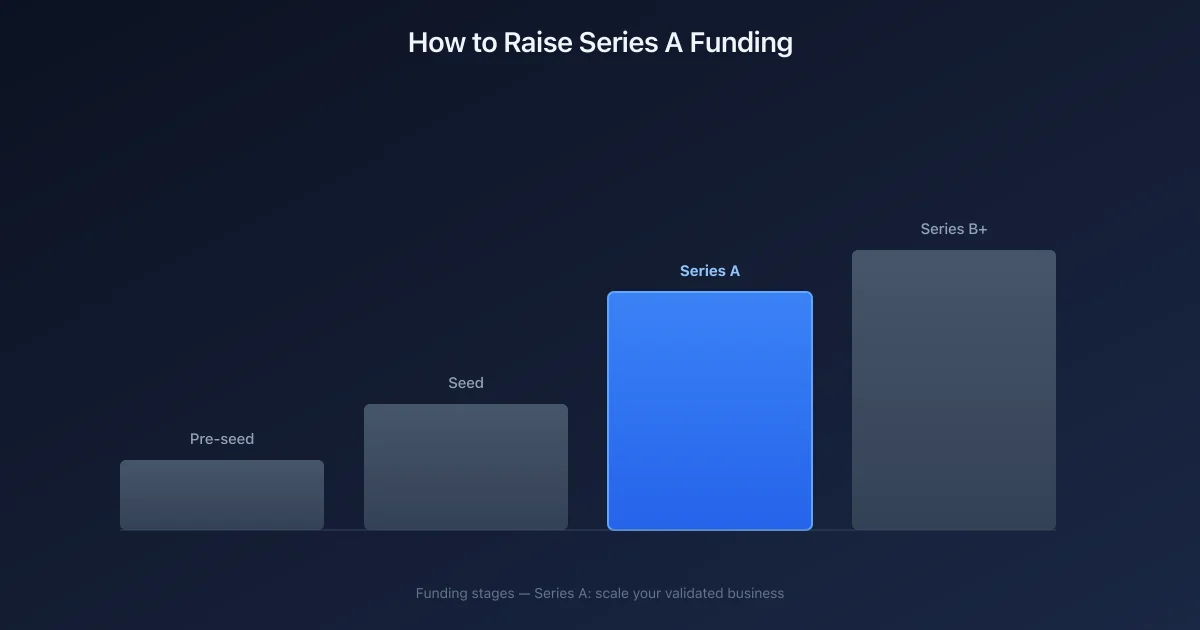
Seed validates the idea and gets you to early traction. Series A scales the validated business. The gap between seed and Series A has widened in many markets: it often takes 24–30 months or more from seed to Series A, so planning runway and milestones matters.
| Seed | Series A | |
|---|---|---|
| Primary goal | Validate problem and solution, reach early traction | Scale validated business, prove repeatable growth |
| Typical amount | Roughly $500K–$2.5M+ | Roughly $2M–$15M+ (median around $10–15M) |
| Typical investors | Angels, micro-VCs, accelerators | Venture capital funds, institutional investors |
| Instruments | SAFEs, convertible notes | Priced round (preferred stock) |
| What investors want | Working product, early traction, strong team | Product-market fit, scalable GTM, strong unit economics |
When Are You Ready to Raise Series A?
Readiness is about milestones and metrics, not a fixed timeline. Investors expect evidence that you can scale, not just that you've built something people use.
You have meaningful traction. For SaaS and many B2B companies, that often means $1M–$3M+ ARR with sustained growth (e.g. 15%+ month-over-month or 100%+ year-over-year). For consumer or marketplace businesses, benchmarks differ: think hundreds of thousands of active users, strong retention, or meaningful GMV with clear unit economics. Benchmarks vary by sector and geography—check ecosystem and cap-table data for your market.
Unit economics are clear and attractive. Investors look for LTV/CAC of at least 3:1 (5:1+ preferred), CAC payback under 12–18 months, and net revenue retention of 90%+ (100%+ ideal for SaaS). Gross margins matter too—70%+ for software is a common bar.
You have runway and a plan. Raising with 8–12 months of runway left is common. You need a clear story for how the new capital gets you to the next milestone (e.g. path to profitability or Series B readiness) and proof that your go-to-market motion is repeatable, not only founder-led.
You can pass due diligence. Clean cap table, clear legal and IP ownership, and financials that match your pitch. Messy books or missing documentation slow or kill deals.
How Much to Raise and at What Valuation?
Series A round sizes typically fall in the $2M–$15M range, with medians in recent years around $10–15M. Raise enough to reach the next set of milestones—often 18–24 months of runway—without giving away more equity than you need. Raising too little forces another fundraise before you have a stronger story; raising too much can mean unnecessary dilution and pressure to deploy capital.
Dilution in a Series A often targets 15–25%. Pre-money valuations vary widely by sector and geography: in the US, $10M–$50M+ is common; in Europe and other regions, valuations often sit 20–35% below US benchmarks. SaaS and high-growth software often command higher multiples; hardware and marketplaces often lower. Use comparable rounds and your traction to justify the range.
If you've raised on SAFEs or notes, model how they convert at different valuation caps so you understand dilution and avoid surprises when the round is priced.
Who Invests in Series A?
Series A capital comes mainly from venture capital funds that write checks in the $2M–$15M range. Many have a lead role: they set the round terms, often take a board seat, and help bring in other investors. Some accelerators and growth-stage funds also participate at Series A, especially for portfolio companies.
Target investors whose check size and stage match your raise. Funds that focus on seed or growth will often pass or offer smaller follow-on checks. Do basic research on portfolio, stage, and sector focus so you're not wasting time on misfit conversations.
Warm introductions from other founders, advisors, or existing investors usually outperform cold outreach. Use early conversations to get feedback on positioning and metrics, not only to ask for a term sheet.
How to Raise Series A: Step-by-Step Process
Raising Series A is a multi-month process. Plan for 3–9 months from first serious outreach to close. Preparation often starts 6–12 months before you need the capital.
1. Prepare Your Materials and Metrics
Your pitch deck should be tight—often 10–13 slides—and include: problem and solution with clear differentiation, traction and key metrics, product overview, market (TAM/SAM/SOM), competitive positioning, go-to-market and customer acquisition, unit economics, and a 3-year projection with assumptions. Investors will dig into the numbers; ensure your financials, cap table, and internal metrics are consistent and defensible.
2. Build a Target List and Start Conversations
List funds that lead Series A in your sector and check size. Prioritize warm paths. Use early meetings to refine the narrative and gauge fit. Don't wait until you're low on runway to start; that weakens your negotiating position.
3. Pitch, Meet, and Narrow
After initial interest, expect deeper diligence: more meetings, reference calls, and requests for data. Respond quickly and accurately. If you have a strong lead, they may help structure the round and bring in other investors.
4. Term Sheet and Due Diligence
When a lead offers a term sheet, you'll negotiate key terms: valuation, board composition, liquidation preference, and any investor vetoes or protective provisions. Series A due diligence usually runs 4–8 weeks and covers financials, legal, cap table, customer contracts, and IP. Clean records and organized documentation speed this up. Resources like YC's Series A diligence checklist and YC's Series A term sheet outline what experienced VCs typically expect.
5. Close and Execute
Legal negotiations finalize the round. Once closed, use the capital to hit the milestones you promised. Hitting milestones is the best preparation for Series B.
Common Series A Mistakes to Avoid
First-time founders often run into the same pitfalls.
Raising before you're ready. If your traction or unit economics don't support the story, you'll get more no's and weaker terms. Wait until you have the metrics and proof that match what Series A investors expect in your sector.
Targeting the wrong investors. Funds that don't lead Series A or don't invest in your space will slow you down. Research check size, stage, and sector before adding them to your list.
Weak or inconsistent financials. Your deck and your books must align. Messy cap tables, missing SAFE conversions, or non-standard revenue recognition create red flags and delay or kill deals.
Desperation. Raising when you're almost out of cash forces bad terms and wrong partners. Start early so you can say no to a bad term sheet and keep talking to others.
Over-optimizing valuation. A slightly higher pre-money can matter less than closing with the right lead who adds value and aligns with your vision. Don't let perfect be the enemy of done.
Ignoring governance and control. Term sheets include board composition and investor rights. Understand what you're agreeing to; founder-friendly structures (e.g. 2-1 boards) preserve optionality for the next round.
Conclusion
Raising Series A funding is a milestone-driven process: you need product-market fit, clear unit economics, and a repeatable path to scale. Typical rounds are priced at $2M–$15M+ with 15–25% dilution; timelines from first pitch to close often run 3–9 months. Prepare materials and metrics early, target the right investors, and run a clean process so term sheet and due diligence move quickly.
If you're still building toward Series A, our guides on pre-seed funding for startups and how to apply to Y Combinator can help with earlier stages. For operations and team building after you raise, see our company building guide. For term sheet and diligence details, Y Combinator's Series A term sheet and Carta's Series A resources are useful references.
Frequently Asked Questions
What is Series A funding?
Series A is a startup's first major institutional venture round. Investors buy preferred stock at a set valuation (a priced round), often with board rights. It typically follows seed funding and is used to scale a validated business—hiring, expanding into new markets, and building repeatable growth.
When should I raise Series A?
Raise when you have strong traction and unit economics: for many B2B SaaS companies, that means roughly $1M–$3M+ ARR with sustained growth, clear LTV/CAC and retention, and 8–12 months of runway. Benchmarks differ by sector (consumer, marketplace, etc.); check data for your market.
How long does it take to raise Series A?
From first serious outreach to closing, plan for 3–9 months. Due diligence alone often takes 4–8 weeks. The time from seed to Series A has extended in many markets—often 24–30 months or more—so plan runway and milestones accordingly.
How much do you raise in Series A?
Typical Series A rounds are $2M–$15M+, with medians in recent years around $10–15M. Raise enough for 18–24 months of runway to hit the next milestones. Dilution often targets 15–25%.
What metrics do Series A investors look for?
They look for product-market fit, repeatable growth, and strong unit economics: ARR or equivalent traction by sector, LTV/CAC of 3:1 or better, CAC payback under 12–18 months, net revenue retention of 90%+ (100%+ ideal for SaaS), and a path to scale beyond founder-led sales.
What is the difference between seed and Series A?
Seed is earlier and smaller: validating the idea and reaching early traction, often via SAFEs or notes. Series A is a priced round from VCs to scale the validated business; it requires proof of product-market fit, repeatable GTM, and metrics that support growth.
What are common Series A mistakes?
Raising too early, targeting the wrong investors, having inconsistent or messy financials and cap table, and raising from a position of desperation. Avoid over-optimizing valuation at the cost of the right lead investor and clean terms.
Do I need a lead investor for Series A?
In practice, yes. Most Series A rounds have a lead VC that sets terms, often takes a board seat, and helps fill the round. Cold outreach without a warm path to a potential lead is harder; use introductions from founders, advisors, or existing investors.
References
- Series A Funding – Carta
- YC Series A Term Sheet – Y Combinator
- Series A Diligence Checklist – Y Combinator
- Series A Funding Guide for Founders – Forecastr
- Your Seed Round Now Needs to Last 3+ Years – SaaStr